Enterprise teams don't need another AI layer sitting outside their existing operation. They need automation that works within the systems, workflows, and accountability structures they already have.
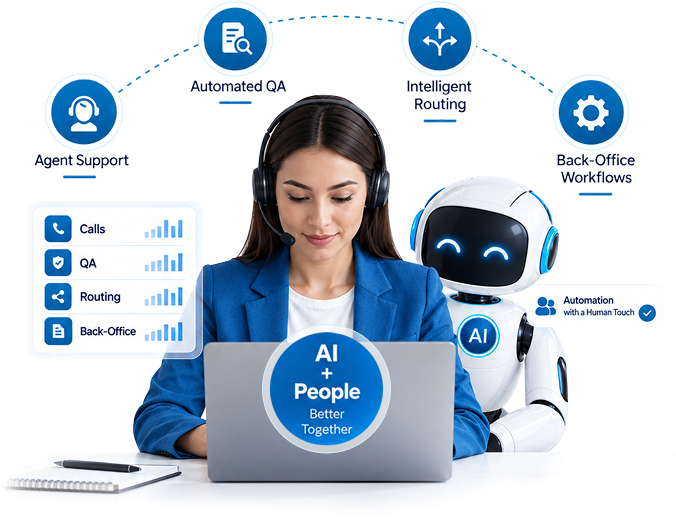
That's the model behind ExpertCallers' ai augmented delivery: engagements stay human-led, with targeted automation layered in to remove real repetitive work. These AI-powered customer service solutions can be scoped across four operational areas based on where manual effort, quality gaps, routing friction, or processing volume are constraining performance.

Agent-Assist & Co-Pilot Support
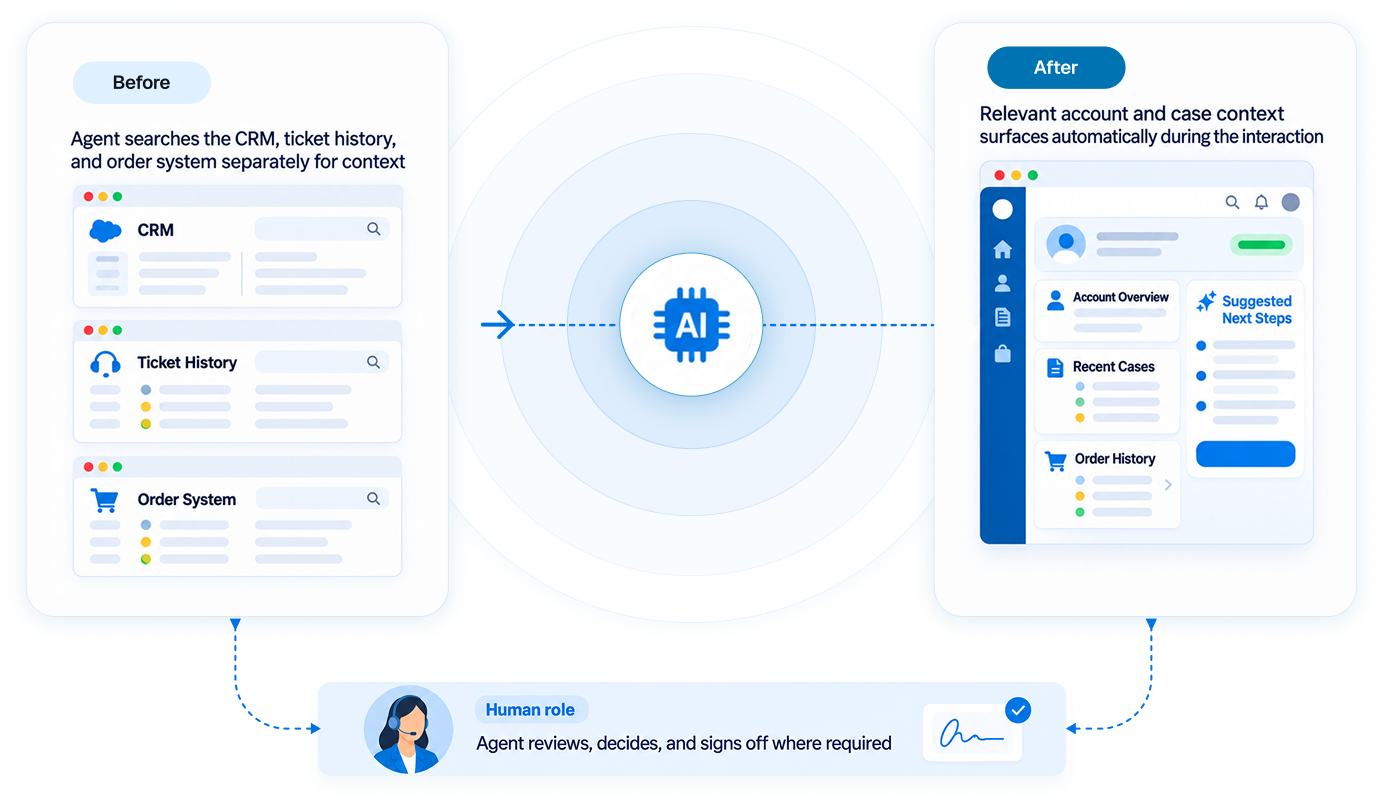
Account history, case notes, and suggested responses surface to a live agent in real time, so a contact doesn't start with the agent searching four systems for context the customer already provided.
What changes: Agents spend less time searching and more time resolving the issue, which can shorten handling time and give agents more context before they respond.
Automated QA & Sentiment Analysis
Every interaction gets scored against a rubric built from your own definition of quality, rather than relying on a small manual QA sample, with sentiment flagged while the conversation is still live.
What changes: QA coverage extends to every interaction instead of a sample, and quality issues surface while there's still time to act on them.

Intelligent Routing & Triage
Routing is based on what the customer actually needs, not just an IVR selection, so contacts reach a skill-matched agent or a self-service path on the first attempt.
What changes: Fewer transfers and shorter time-to-resolution, because contacts reach the right place the first time.
Workflow Automation for Back-Office & Data
RPA handles tasks such as order corrections, refund initiation, and structured data entry, wired into the same case record your support agents use rather than a disconnected back-office system.
What changes: Repetitive back-office processing is standardized and takes less manual effort, without creating a second system of record.
AI Does the Repeatable Work. People Retain Control Where Judgment Matters.
These AI and human hybrid support services operate inside boundaries a client defines, rather than boundaries a model determines on its own:
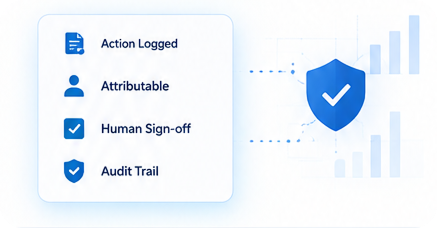
- Pre-approved action boundaries for what AI can execute without review
- Human sign-off on anything outside that boundary
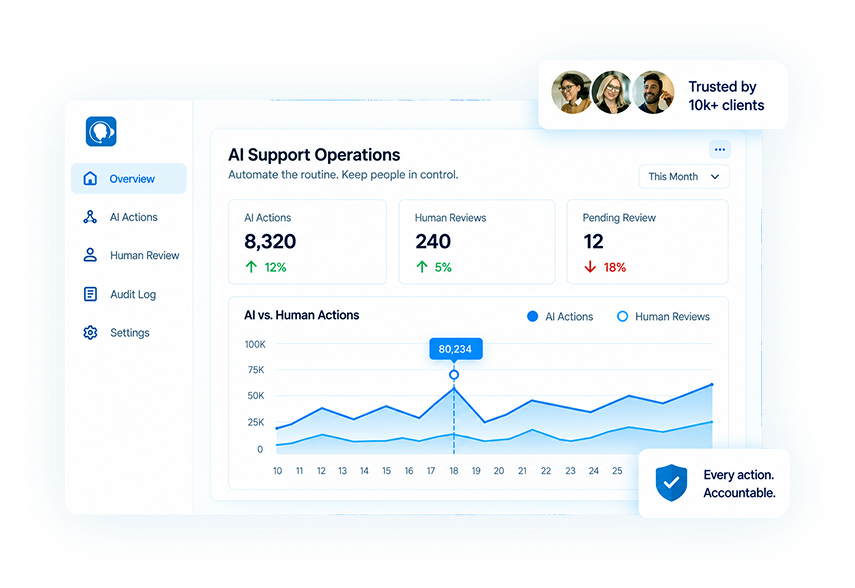
- Every AI-initiated action is logged and attributable
- A full audit trail that plugs into your existing governance, not a parallel one
What This Looks Like in Production
How It Works
Workflow Automation & Agentic AI Skills
01
What does your "workflow automation" actually do, beyond a chatbot?
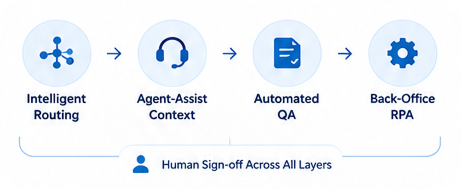
Four layers work together: intelligent routing, agent-assist context, full-coverage automated QA, and back-office RPA, with human sign-off across all four. Each layer above breaks down the mechanics.
02
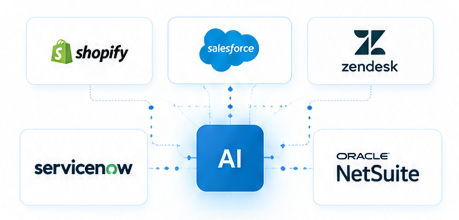
Can your automation integrate with our existing stack, such as Shopify, Salesforce, Zendesk, ServiceNow, or NetSuite?
The workflow layer is designed to sit on top of your existing CRM, OMS, and ticketing systems rather than replace them. This allows agentic AI in customer support to surface context, recommendations, and approved actions within the tools your team already uses.
03
Who is accountable when an AI agent takes an action, and how is that audited?
Every AI-initiated action is logged and attributable, and a trained agent retains sign-off on anything outside a pre-approved, low-risk action set. That keeps the audit trail intact for regulated clients and makes responsibility clear when automation is involved.
04
Can we start with one workflow before expanding?
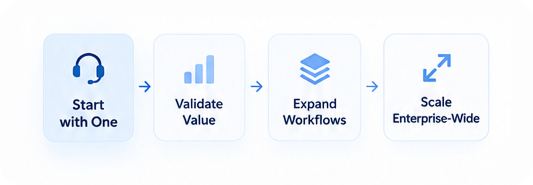
Yes. Most engagements can start with a single layer. Agent-assist or automated QA are common entry points that prove the workflow, then expand to routing and back-office automation once it has been validated.