
 866-784-0925


Introduction
Picture this: A traveler stranded in Bangkok at midnight, reservation canceled by error, no English-speaking staff available, and the hotel helpline playing an automated loop in a language they don’t understand. Within hours, this guest posts a scathing review across five platforms. By morning, the damage is done; potential customers see a brand that doesn’t care when things go wrong.
This is an imaginary scenario, but thousands of instances like this happen daily across the travel industry. One lost conversation becomes a viral complaint that reshapes perception. In today’s hyper-connected world, hospitality excellence is no longer just about clean rooms and prompt service. It’s about being linguistically inclusive and meeting guests where they are, literally in their own language.
The stakes have never been higher. Travel brands investing in multilingual helpdesk teams are now trying to build a business imperative that never fails.
The New Guest Expectation: “Talk to Me Like You Know Me”
Modern travelers demand personalization. That personalization no longer stops at remembering their preferred pillow type or favorite table by the window. Today, it extends to language and cultural awareness so that they do not struggle to communicate.
Recent data tells a compelling story. UNWTO’s “Tourism Towards 2030 / Global Overview” forecasted 1.8 billion international arrivals by 2030. The UNWTO press release also states that emerging economies (Asia, Africa, etc.) will gain more arrivals.
The expectation gap is widening. Guests resent being misunderstood (which is fair enough, considering they have visited a foreign country), won’t you? A traveler might forgive a delayed airport shuttle or a room upgrade that never materialized. But being unable to explain their dietary needs, accessibility requirements, or emergencies in a connecting language? That’s frustrating and ruins the entire trip. Travel brands that recognize this shift gain a competitive edge. When a guest’s language is spoken fluently by support staff, every interaction feels less transactional and more human. It signals respect for their identity, not just their wallet.
When Words Fail, Revenue Follows
Another instance of the mechanics of failure: A guest books a room with specific requirements but encounters a translation glitch during checkout. What should take 10 minutes takes 45. The interaction feels frustrating. The guest leaves a three-star review instead of five. Multiply this across hundreds of guests monthly, and you will see conversion rates drop measurably.
Many travelers would pay a premium for brands with multilingual support. One can’t neglect it just considering it as minor preference shifts, but if you think deeply, they are revenue generators perched on somebody else’s garden.
Review platforms amplify communication failures instantly. A guest who experienced a language barrier broadcasts their experience across TripAdvisor, Google, Booking.com, and social media simultaneously. A single unresolved query becomes a reputation crisis. Conversely, brands that solve problems in a guest’s language earn fierce loyalty and word-of-mouth advocacy that algorithms reward.
The math is simple. Poor language support means lower ratings, fewer bookings, and compounding losses as bad reviews push new customers toward competitors.
The Multilingual Helpdesk: Where Service Meets Culture
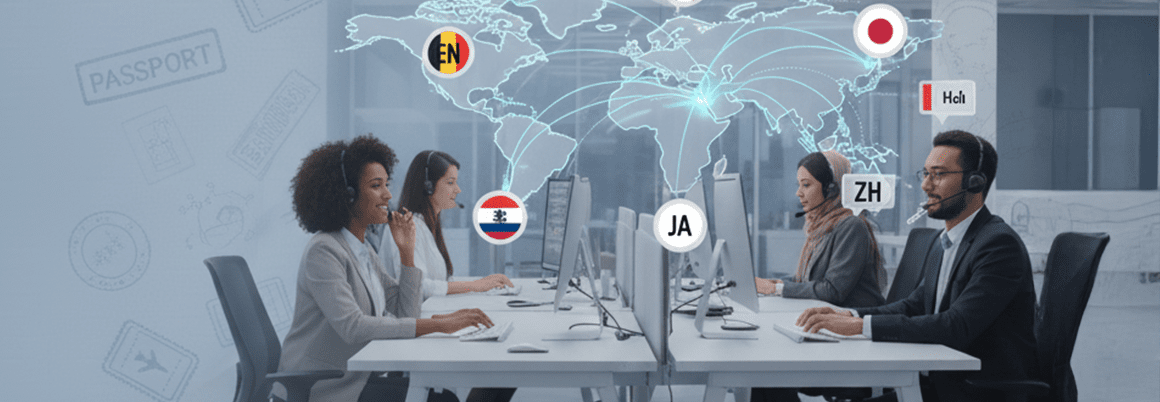
A hotel’s front desk is where guests feel most heard. But in the digital age, the helpdesk is the new front desk. It’s the voice guests remember most, the interaction that defines their entire experience before, during, and after arrival.
Multilingual helpdesks transform this touchpoint into a trust-building asset. Several things happen simultaneously when a guest calls with a problem and hears fluent support in their expected language. The anxiety drops. The sense of isolation dissolves. Suddenly, the guest feels like a valued person, not a transaction being rushed through. In short, multilingual support transforms service from transactional to relational. Every interaction becomes an opportunity to deepen emotional connection.
Tech-Human Synergy: The New Language of Service
Technology alone cannot replicate human empathy. But it can amplify human capability exponentially. Leading travel brands are deploying AI translation engines, NLP-powered chatbots, and intelligent CRM systems that work in tandem with multilingual teams. These tools handle routine inquiries in dozens of languages simultaneously, freeing human agents to focus on complex, emotionally nuanced conversations where cultural understanding matters most.
The magic lies in this glorious synthesis of human and technology. An AI chatbot can resolve most common queries instantly in any language. But when a guest’s issue escalates, a human agent steps in with full context, language fluency, and emotional intelligence. The guest doesn’t feel like they’ve been passed to a script; they feel elevated to a real person who cares.
Furthermore, smart CRM integration enables agents to respond in a guest’s native language with complete booking history, preferences, and past interactions visible briefly. For instance, a guest calls in Portuguese. The system immediately flags it as Portuguese speakers, pre-loads their reservation, and the agent greets them in their language with specific knowledge of their stay. So, you can expect no waste of time in “hold on, let me look that up.” Just seamless, informed service.
This human-in-the-loop model is both efficient and scalable. Brands can now deliver personalized multilingual service across 24 time zones without sacrificing the quality of care offered.
Global Hospitality, Local Voices
The misconception persists that multilingual helpdesks are luxuries for five-star chains and massive OTAs. The reality is far different. A boutique hotel in Mexico City serving guests from 40+ countries. A travel startup connecting adventure seekers globally. A regional bed-and-breakfast leveraging multilingual chat to compete with larger chains. These brands are discovering that linguistic inclusivity is achievable nowadays, in the rapid progress of technological features, not an elite feature.
According to an article on Cyracom, 71.5% of leaders in the hospitality industry say multilinguals support, especially in their native language, increases customer satisfaction. Smaller players are also adopting the same techniques. They might not be very rich in resources, but they’re rich in ambition and understand that global tourism means local responsibility.
Guest diversity is undeniable. Every day, international travel booking platforms host interactions between travelers from over 100 countries. A guest booking a New York hotel might be Brazilian, speaking Portuguese. Their partner might be Japanese, preferring Japanese-language communication. Their travel agent might be German. In this ecosystem, monolingual support offers very limiting experiences.
Brands winning loyalty today are those that recognize this diversity and make multilingual service a non-negotiable feature, regardless of brand size or budget tier.
The Outsourcing Revolution
For many travel brands, the fastest path to global readiness is multilingual outsourcing. Specialized partners bring trained, culturally aware agents, advanced technology infrastructure, and round-the-clock coverage across time zones; capabilities that would take years to develop in-house.
Expert outsourcing providers hire people who speak multiple languages with cultural fluency, hospitality background, and emotional intelligence. They invest in continuous training on industry-specific terminology, brand voice, and de-escalation techniques. They maintain quality standards that match or exceed in-house teams.
Hospitality Without Borders
The future of travel is being written by brands that recognize a fundamental truth: language isn’t a barrier to hospitality, rather it’s a gateway to it. Check what your business can do, regardless of size. Evaluate your linguistic inclusivity. Deploy multilingual help desks where guest demand exists. Invest in teams that understand cultures alongside language.
Partner with Expert Callers to scale global readiness faster than internal development allows. Contact us to learn more about how we can offer you multilingual support.
FAQ
How do multilingual helpdesk teams improve customer experience?
They remove language obstacles, ensure precise understanding, and offer culturally appropriate services that lead to improved guest satisfaction and loyalty.
What are the languages in demand for travel customer support?
English, Spanish, Mandarin, French, German, Arabic, and Japanese are the most requested due to their global traveler base and market coverage. But it varies across regions.
Are multilingual support teams more effective than AI translation tools?
Yes. Human agents provide cultural sensitivity and contextual accuracy that automated translation tools often lack, especially in emotional or complex cases.
How do multilingual helpdesk teams benefit global travel agencies and hotels?
They enhance market reach, increase brand value, and optimize the different response levels for international clients, which encourages customer loyalty.
Can small travel companies afford multilingual helpdesk support?
Yes. Outsourcing global language support offers small travel companies access to multilingual services and expertise.
What are the technologies that support multilingual call center operations?
AI-enhanced CRMs, real-time translation tools, sentiment analysis, and omnichannel helpdesk systems provide integrated multilingual support.
What are the ways multilingual helpdesks address cultural differences in client service?
Helpdesk personnel are coached in various cross-cultural manners and modify their tone, styles, and problem-solving methods for the customer.
What are the returns on investments for multilingual customer support?
Greater customer acquisition, reduced turnover, and customer satisfaction correlate with revenue increases and enhanced brand value on the international market.
What are the ways travel companies can begin establishing a multilingual help desk?
Travel companies can begin by determining their main target markets, acquiring the main languages, and collaborating with reputable outsourcing firms that guarantee quality and the ability to grow.
 Prev
Prev


