866-784-0925
  EMAIL
EMAIL  CHAT
CHAT 



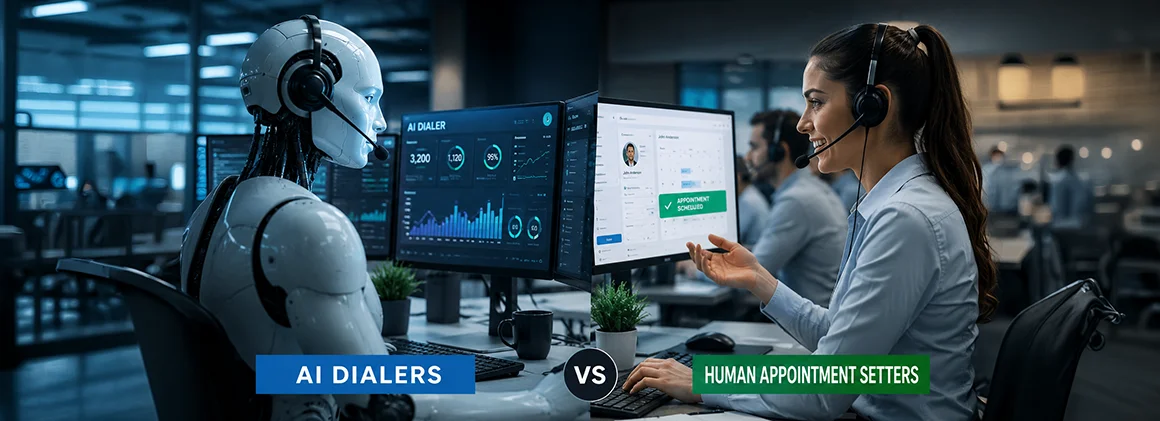
Operations leaders are stuck in a dilemma today: whether to replace their human appointment setters with AI agents or continue using the traditional method of converting leads while fighting with AI systems that are here to stay.
However, the question isn’t about who makes the call, but about how much value that one call creates in the sales sequence.
Choosing between AI and humans is futile, especially if you engage in the either-or debate, because both methods solve different problems. AI solves for volume and the exhaustion of the unreachable lead. Humans solve for nuance, trust, and the navigation of complex organizational barriers.
Let’s understand how AI dialers and human appointment setters differ in their purpose, approach, and outcomes.
What “Conversion” Actually Means in Outbound
What amounts to conversion in a high-performance outbound environment can differ according to the context.
Not considering it as a monolithic metric, it amounts to a series of handoffs where value is either preserved or lost. Most organizations make the mistake of measuring the success of an appointment setter, whether AI or human, solely by the number of meetings on the calendar.
But that’s the wrong approach.
To fully understand what conversion means, we need to interpret it through the lens of resource allocation and lead decay.
| Metric | AI Performance Impact | Human Performance Impact | System-Level Outcome |
|---|---|---|---|
| Contact Rate | High efficiency in reaching high volumes of cold leads | Lower efficiency due to manual constraints. | AI reduces the cost of the initial “break-in” phase. |
| Meeting Booked Rate | High, often driven by persistence and instant follow-up. | Moderate, limited by the number of calls per hour. | AI scales the top of the funnel faster than any human team. |
| Show-up Rate | Often lower due to lack of emotional buy-in. | Significantly higher due to established rapport. | Human intervention ensures the prospect feels an obligation to attend. |
| Sales-Qualified Rate | Often diluted by prospects who “just said yes” to end the call. | Higher, as humans vet for technical and budget fit. | Human setters protect the time of the most expensive sales assets. |
| Close Rate | Minimal impact on the final sale. | High impact through proper discovery and handoff notes. | The quality of the setter dictates the momentum of the closing rep. |
There’s an Intent Gap | Let’s Recognize That
AI dialers work with a singular mission: to book meetings as if it’s a mathematical problem. You give an AI system 1000 calls per day, and inevitably, some people will agree to a meeting.
But this is a false positive conversion. We say this because the friction of saying no to a persistent machine is higher than the amount of work needed to accept a meeting.
On the other hand, when a human telecaller engages with a prospect, they don’t just read from a script, but enter into a conversation, sort of, a micro-negotiation. Instead of asking just for the prospect’s time, they assess:
- Tone
- Hesitations
- Business pain
By filtering all these friction points, human appointment setters bring qualified leads to the sales team. Without this qualification, the sales team gets frustrated with empty calendars, lead-to-close ratios plummet, and the cost of customer acquisition (CAC) rises despite the lower cost of the initial AI outreach.
The real conversion happens when a prospect moves from willing to listen to ready to solve a problem. By shifting the human setter from a volume dialer to a high-intent validator, businesses stop wasting their most expensive resources (sales executives) on low-probability conversations.
First, analyze on your end whether your existing outbound model is designed to maximize meeting volume or the velocity of closed deals.
How to Measure What Actually Matters
Measuring progress and outcomes with each approach is essential as you cannot optimize what you can’t measure.
Tier 1 – Activity Metrics
- Dials per day: Outreach volume baseline
- Connect rate: Percentage of dials that become live conversations
- Conversation-to-qualified: Efficiency of first-level filtering
Tier 2 – Quality Metrics
- Qualified-to-booked: Conversion from interest to commitment
- Show rate: Booked meetings that actually happen (key differentiator)
- Recovery rate: Percentage of no-shows salvaged
Tier 3 – Revenue Metrics
- Booked-to-closed: True conversion by source (AI vs human)
- Cost per qualified meeting: Real acquisition cost
- Cost per closed deal: Revenue efficiency benchmark
- Pipeline per setter: Contribution to revenue
Where AI Dialers Actually Perform Better than Human Appointment Setters
We cannot completely dismiss the capabilities of AI dialers; they are here, and we must learn to integrate AI into our workflow, but at what stage, that is important.
AI dialers have fundamentally altered the economics of top-of-funnel (TOFU) outbound calls by solving the primary constraint of human teams with the high volume of work and non-stop calling it provides.
AI Dialers Increase the Speed to Lead
- Reduce Lead Latency: In high-volume environments, AI dialers function as a force multiplier that eliminates the cold start problem and reduces lead latency.
- Simultaneous Calling: AI dialers can contact people across time zones, simultaneously process thousands of data points, giving near instant speed to lead. Also, this changes the cost structure from variable expense to fixed software-based cost.
For broad, cold outreach where the objective is simple qualification or identifying low-hanging fruit, AI is unmatched.
Expert Caller’s Multilingual Outbound Calling System Drove 300% Sales Growth. See How!
AI Excels at Pattern Recognition
- Calling Trends: AI dialer systems are great at identifying optimal calling windows and lead-scoring trends that humans can’t or won’t pay attention to.
- Feedback Loop: Using this data, the operations team can create a data-based feedback loop and gain tactically important information with precision.
If the goal is to exhaust a database of 50,000 cold leads to find the 5% who are currently in a buying window, AI is the only viable tool for the job.
Hidden Costs of AI Dialers
- Prompt Engineering: Ongoing AI dialers tuning requires time and ownership.
- Compliance Infrastructure: TRAI (India), TCPA (USA), DNC scrubbing, and AI disclosure are necessary.
- QA Oversight: Humans must still monitor AI systems for errors, misqualification, or misinformation.
- Integrations: CRM, calendar, and workflow setup add real implementation cost to the AI dialer systems.
- Brand Risk: Undisclosed AI interactions can erode trust and brand reputation.
Where Human Appointment Setters Do Better
The moment the conversation deviates from the predetermined linear path the AI is trained to follow, its impact decreases because the AI cannot understand the new context added to the conversation.
- Processing Intent: Humans understand emotions, and their ability to manage the nuance of a live conversation is where true conversion happens.
- Trust-Building: Human callers don’t just listen to some specific words; instead, they are trained to listen closely and infer hesitations, changes in tone, and unstated objections.
The moment a prospect has a complex concern or an emotional barrier, human appointment setters can change the script in real time to connect the problem to the solution the company provides.
A prospect who feels understood by a human setter arrives at the sales meeting with a sense of obligation and curiosity. Conversely, a prospect who was pushed through an automated sequence often treats the meeting as an optional interruption.

Where to Use Human Appointment Setters and AI Dialers in the Funnel Breakdown
The best outbound systems don’t choose one; they deploy both resources at the right stage and with a specific mission.
| Funnel Stage | Winner | Why |
|---|---|---|
| Cold Outreach | AI Dialer | High efficiency in reaching high volumes of cold leads |
| Initial Qualification | AI Dialer | High, often driven by persistence and instant follow-up. |
| Deep Qualification | Human Setter | Significantly higher due to established rapport. |
| Sales-Qualified Rate | Human Setter | Higher, as humans vet for technical and budget fit. |
| Close Rate | Human Setter | High impact through proper discovery and handoff notes. |
By using AI to filter the qualified leads from a long list of prospects, human setters can focus on high-value interactions. This ensures that the human team is only ever talking to prospects who have already passed a baseline of interest, maximizing their high-cost expertise.
Mistakes Businesses Must Avoid with Outbound Calling
Efficiency Trap:
AI dialers are efficient in their work, no doubt about that. But in a spreadsheet, the low upfront cost of AI-driven outreach is mistaken for a net gain in revenue, which it is not. Seeing this, companies reduce their outbound team only to find themselves battling for qualified leads later.
Ignoring Downstream Costs:
Using only AI dialers results in low-intent conversions that, down the line, add to lead-generation costs.
Meeting Debt:
System-run dialers have only one focus: high-volume of calls and meeting set-ups. This creates a meeting debt, as the closing team has limited time to take on calls each day.
High Closing Cost:
With a high volume of meetings generated through automated leads, the executives will spend some portion of their time convincing people who are genuinely not interested. This wasted effort costs a company more than having a good outbound strategy.
What High-Performance Teams Actually Do in a Hybrid Approach
The most resilient outbound systems don’t choose between AI dialers and human appointment setters. The hybrid structure they follow is two-pronged:
- AI dialers scout prospects with speed
- Human setters specialize in closing the lead
This model recognizes that the first 90 percent of outbound work is a data and persistence problem, while the final 10 percent is a psychological and relational one.
In the hybrid approach, AI handles all the heavy lifting, making thousands of calls, filtering inactive and non-interested prospects, and doing the basic task of filtering genuine prospects from the crowd.
As soon as a prospect shows interest, human setters enter the conversation, taking the prospect down the funnel and establishing intent with the right context.
Conclusion
Success in modern outbound calling is not just about how many calls your team can make in a day, but it’s about how many prospects you convert into customers.
Where AI is great at identifying interest at scale, the human connection is still an indispensable factor to convert that interest into a revenue-generating sales conversation.
ExpertCallers operates at this precise intersection as we believe that AI and humans are two halves of a high-performance revenue engine.
We deploy a proven hybrid model integrating automated systems with the strategic inclusion of professional human setters in the process. We protect your brand and your closing team’s time.
 Prev
Prev